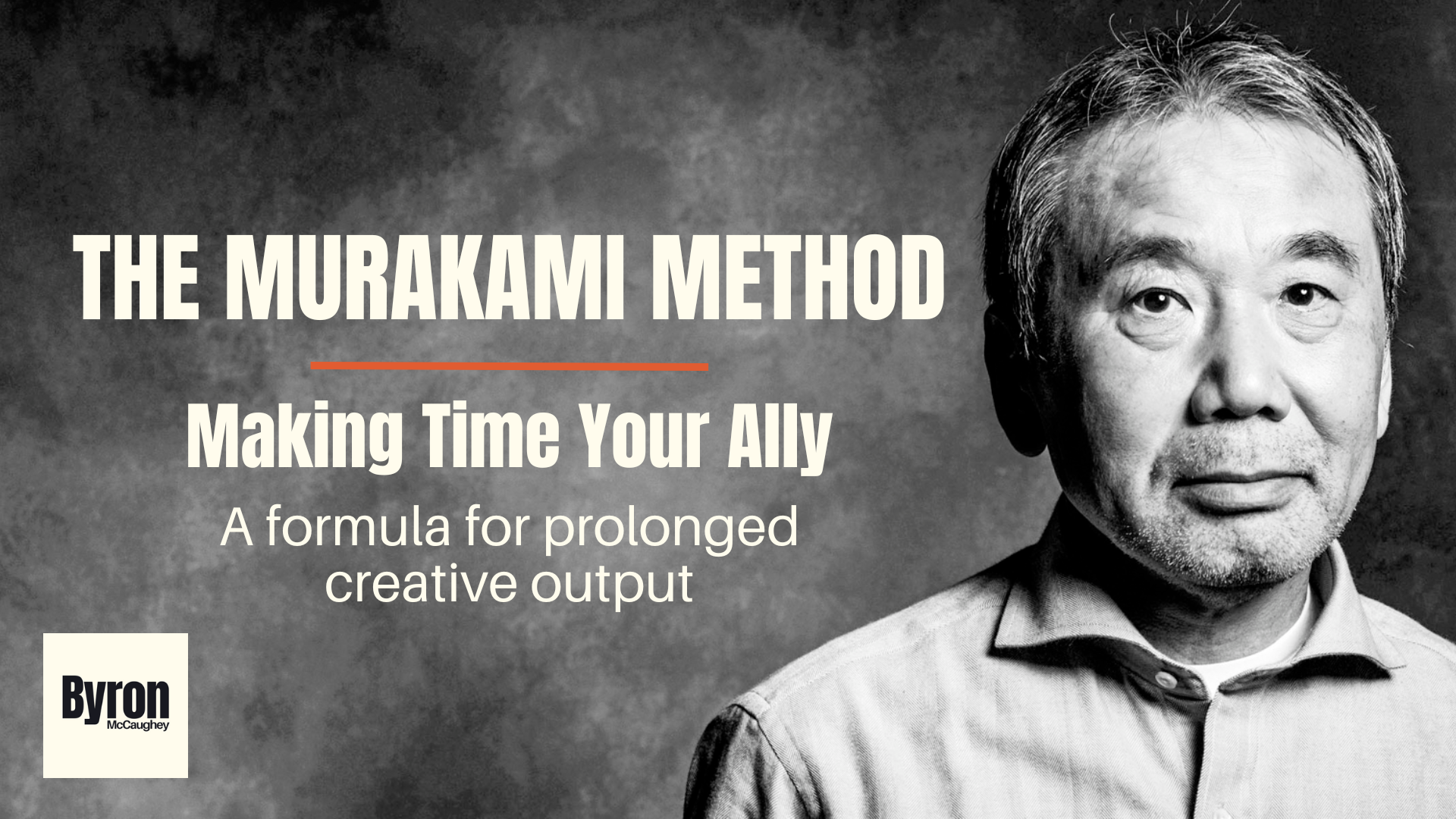
Haruki Murakami has a rather unique relationship with time.
On the one hand, time is fleeting and it fuels his urgency, ensuring a steady output of words when writing novels. On the other hand, he sees time as abundant, allowing him ample opportunity to let his work settle before releasing it to the world.
The result is a formula that has supported him in creating quality novels for over 40 years, with Killing Commendatore being my personal favourite.
When tackling a novel, Murakami has a rule of writing 1,600 words a day, equivalent to roughly three typed pages. No matter how he is feeling, the conditions in his life, or the strength of internal resistance to do the work, he will sit down each morning and fill his quota.
This disciplined approach builds creative momentum, which compounds daily. It also keeps our mind engaged, allowing ideas to evolve naturally and reducing the pressure to produce something brilliant in a single sitting. A little creative work on a lot of days is better than a lot on a few days.
Now for the other side of the coin—stepping away. Once the first draft is finished, Murakami tucks it away in a drawer and deliberately forgets about it. After the first rewrite, he does the same for a week. The second rewrite, another week. The final rewrite, two weeks. And before sending it to his editor, he lets it sit for up to a month.
Why is this distance so important? Time away allows the mind to process ideas subconsciously, revealing weaknesses and areas for improvement that weren’t obvious in the moment. It’s like sleeping on a big decision—where uncertainty is replaced by striking clarity the following morning.
It’s a careful balancing act of using time as fuel for consistent output while resisting the urge to rush unfinished work into the world. Murakami’s method shows that creativity isn’t just about inspiration; it’s about discipline, patience, and knowing when to step back. Next time you’re working on a creative project, try his approach—work a little every day, then give it space to breathe. You might be surprised at what emerges.
Part of Short Tales of Psychology—a series about interesting humans and the psychological lessons we can apply to enhance our mental wellbeing and optimise performance.