James Dyson: Success Through Failure - And How To Stop Avoiding It
By Byron McCaughey · 28 October 2025
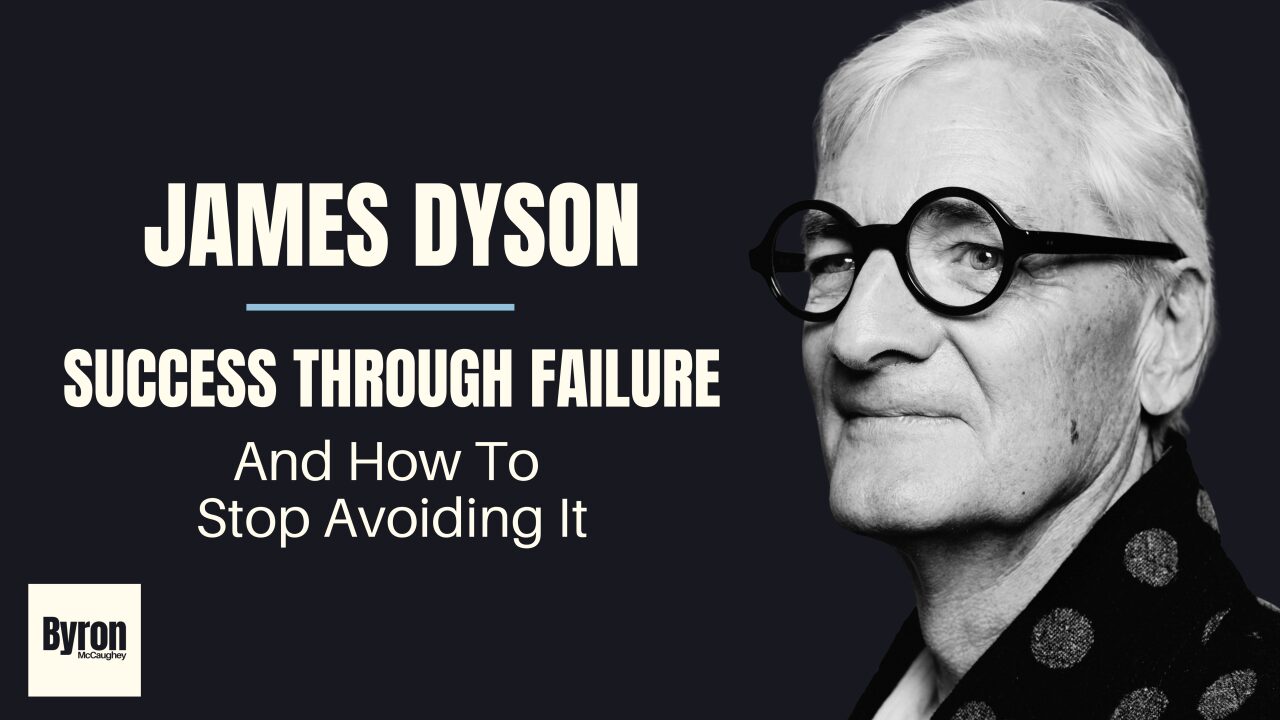
James Dyson describes his life as one of failure.
After all, he endured 5,126 failed prototypes over five years before successfully creating the bagless vacuum.
However, let’s be clear: this ‘life of failure’ has created a company that revolutionised vacuums, employs thousands and is worth billions. Not to mention making bathroom hand dryers actually worth using!
Now it’s easy to say to ourselves that we’ll subscribe to Dyson’s philosophy that ‘the key to success is failure’, but the real question is: how do we actually live by it?
Avoidance is the single biggest factor stopping you from living a life where you explore without fear of failing. Avoidance of the feeling of being wrong.
Before we go any further, let’s clarify why, from a business context, a life where we do not avoid failure benefits us:
You are more innovative
You procrastinate less
Your learnings compound
You handle pressure better
You have more fun
I’d say that’s a pretty good list.
So how do we stop avoiding failure and free ourselves from the fear of being wrong? There are a few ways, but the one I believe is most impactful: awareness.
More specifically, awareness of our avoidance behaviours.
You see, avoidance can be subtle – overpreparing, procrastinating, endlessly perfecting. It can also be obvious, like not starting at all.
Ask yourself: “What am I doing to protect myself from the feeling of being wrong?”
Once we can name the avoidance, we can work with it – and, as Adam Grant says in Think Again, find the joy of being wrong.
Does failure feel good? Of course not. But it doesn’t need to be feared. And the more we fail, the more we teach ourselves that a life lived in alignment with our values is far more enjoyable than a life lived in a protective bubble, avoiding the failure monster.
What is one subtle avoidance behaviour you’ve recognised in your own journey?
Part of Short Tales of Psychology - a series about interesting humans and the psychological lessons we can apply to enhance our mental wellbeing and optimise performance. Subscribe here.
BM
Byron McCaughey
Psychologist for Entrepreneurs. Former VC-backed founder. Writes Short Tales of Psychology.