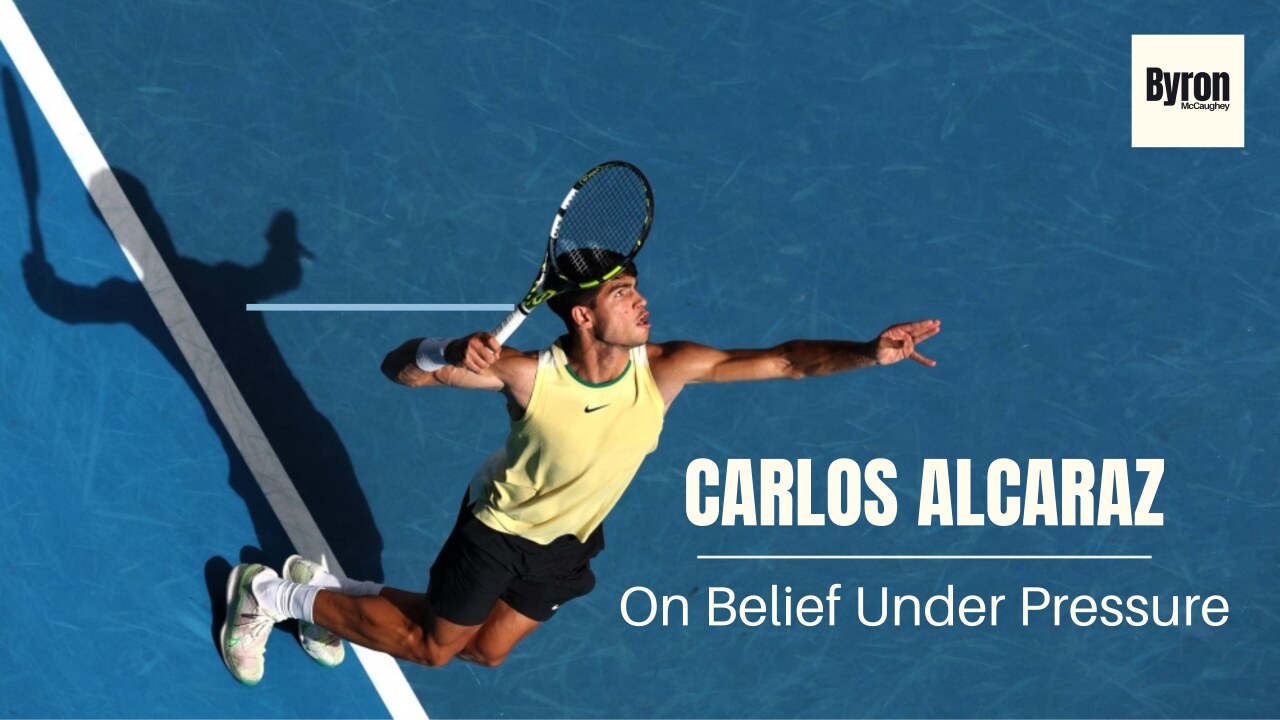
← Back to insightsCarlos Alcaraz on his way to winning the Australian Open 2026 | Photo credit: AFP JIJI
Confidence · Performance Psychology · 3 min read
Carlos Alcaraz: On Belief Under Pressure
By Byron McCaughey · 4 February 2026
Watching Carlos Alcaraz throughout the Australian Open 2026, I noticed something. When he’s under pressure – break points, tiebreaks – he hits harder. He aims closer to the line. In other words, when the pressure rises, so does his willingness to take risks.
That’s not how most of us act when the stakes are high.
In those moments, Alcaraz doesn’t play to avoid loss; he plays to win. There’s an inner belief that shines through in his behaviour. He commits more fully to his game rather than abandoning it to stay safe. And more often than not, this allows his best tennis to show up.
Now increasing risk also increases the chance of hearing the robotic “out!” echo around Rod Laver Arena. He knows that. But if he does lose, he does so under his own terms – having acted in line with the player he wants to be.
Many people do the opposite when the pressure is on. They tighten up. They hold back. They shift into protection mode, trying to preserve what they have. Psychologically, this is a loss-avoidance mindset. Behaviourally, it shows up as hesitation, a lack of commitment and fear.
I see this regularly in session with entrepreneurs facing revenue pressure. As targets loom, decisions become safer and more risk-averse. Clients who aren’t quite right are taken on, creating problems later. Prices are dropped to close deals. We rationalise it in the moment - a way of protecting what’s been built - but the longer term cost is a person and a business slipping away from what they stand for.
So how do we avoid slipping into this loss-avoidance mindset?
The first step is noticing the mind’s storylines that pull you there. A common one is: “If this doesn’t work, I’ll feel like a fool.” Your mind then kicks in with behaviours designed to protect you from this discomfort. The problem is that these behaviours often lead you to play it safe, misalign with the type of person you want to be, and harm your performance.
Next time you are under pressure, try to reframe the situation. Rather than asking “How do I avoid losing?”, ask yourself, “How would I act if I wasn’t afraid?”
Part of Short Tales of Psychology - a series about interesting humans and the psychological lessons we can apply to enhance our mental wellbeing and optimise performance. Subscribe here.
BM
Byron McCaughey
Psychologist for Entrepreneurs. Former VC-backed founder. Writes Short Tales of Psychology.