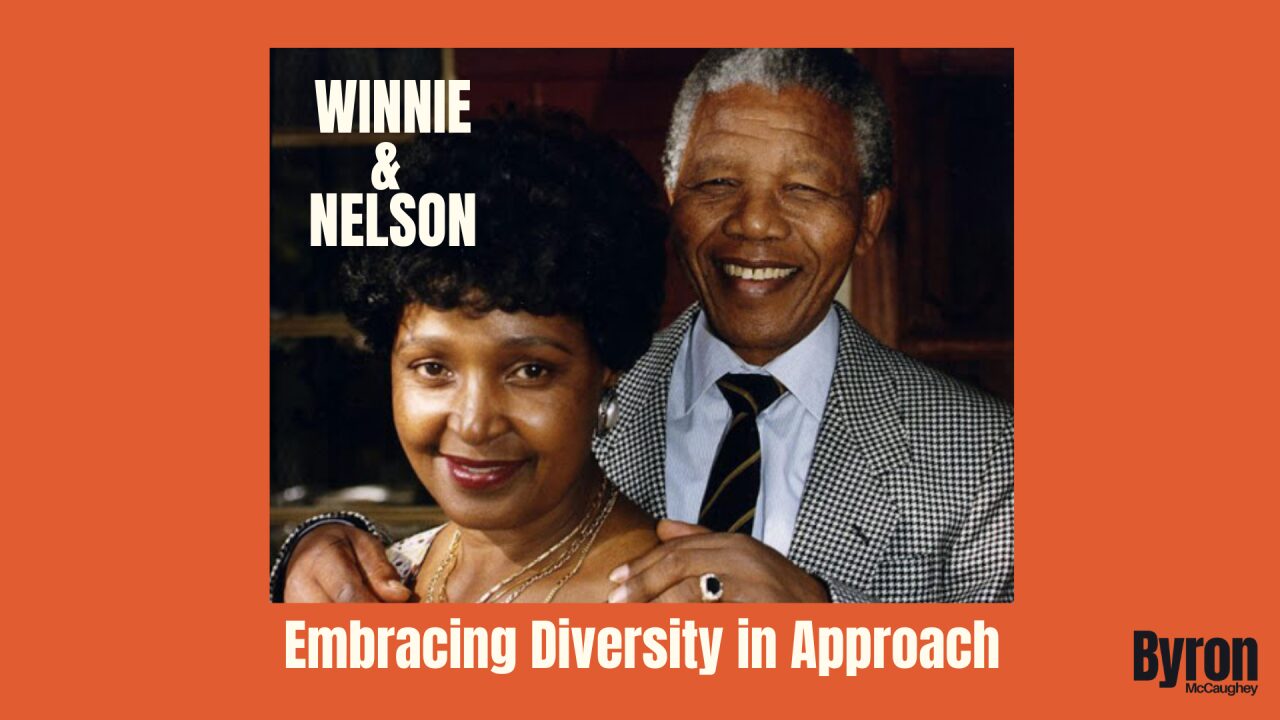
← Back to insightsNelson Mandela and Winnie Madikizela-Mandela | Credit: Alamy
Creativity · Resilience · 2 min read
Winnie & Nelson: Embracing Diversity in Approach
By Byron McCaughey · 17 July 2024
Winnie and Nelson Mandela shared a vision of dismantling apartheid in South Africa but had rather contrasting approaches to achieving that vision.
Winnie adopted a strategy focused on grassroots activism and direct action. She was heavily involved in organising protests, mobilising the masses, and supporting resistance activities.
On the other hand, Nelson emphasised peaceful negotiations, reconciliation and forgiveness - even after being imprisoned for 27 years. He also focused on international advocacy, becoming the global symbol of the anti-apartheid struggle.
These distinct approaches weren't without controversy, yet they both played a crucial role in ultimately reaching their goal. In 1994, South Africa held its first democratic elections in which all races could vote.
What can we learn from Winnie and Nelson's story when considering moments with co-founders, colleagues, and even lovers where we want the same thing but can't quite agree on how to get there?
Let's first recognise that we often seek out and form relationships with others who share our thoughts, beliefs, and behaviours. This satisfies our psychological need for belonging and conflict avoidance, while also creating cohesion and trust.
The issue arises when this bias causes us to overlook the value of diverse perspectives and approaches. It limits our problem-solving ability and creativity, as we become trapped in a loop that reinforces our existing views and playbook.
Here are some ways to create an environment that encourages diversity in approach:
Confirm you have a shared vision. Are you just proposing a different route, or are you actually heading to different destinations?
Practice active listening. This means being present, listening without an agenda (e.g., not planning your rebuttal), and being curious.
Encourage conflict. Not emotionally fuelled conflict - that hinders progress. Rather, task conflict, where you debate the how and why of different strategies.
Consider where in your life you might solicit diverse opinions and perspectives on your approach. You might just discover a better way of moving towards your common goals.
Part of Short Tales of Psychology - a series about interesting humans and the psychological lessons we can apply to enhance our mental wellbeing and optimise performance. Subscribe here.
BM
Byron McCaughey
Psychologist for Entrepreneurs. Former VC-backed founder. Writes Short Tales of Psychology.