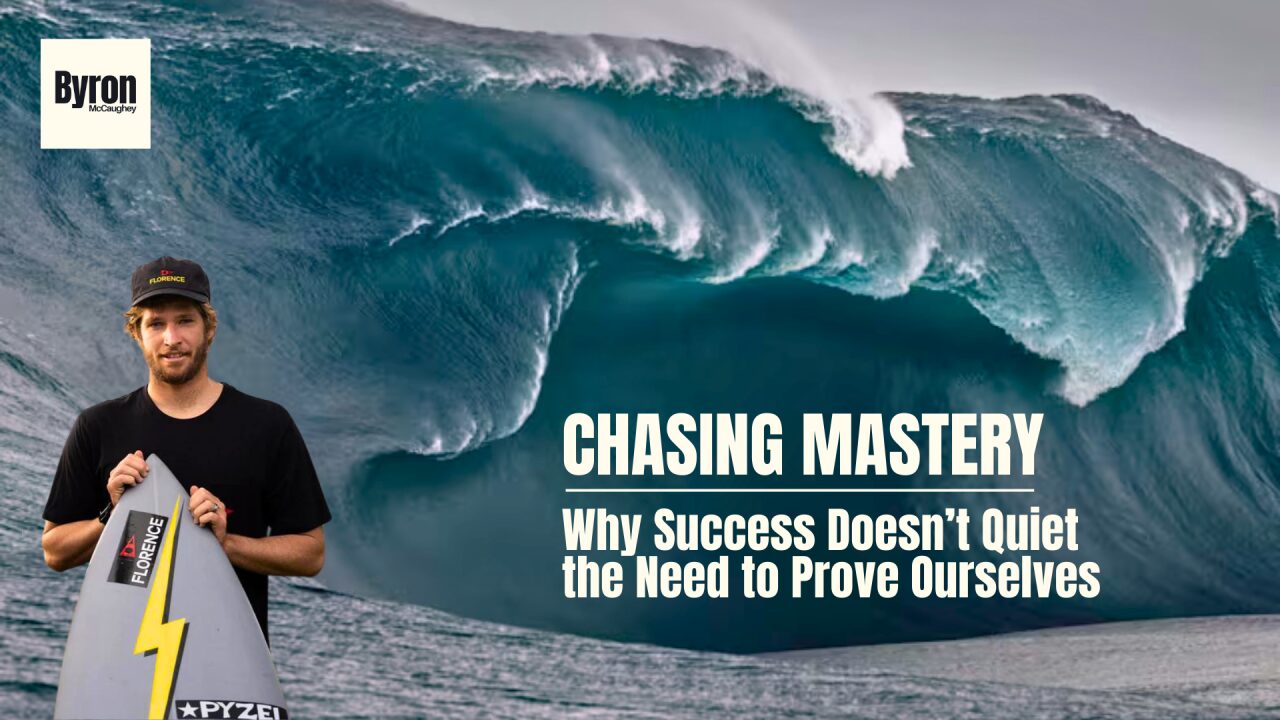
← Back to insightsNathan Florence (credit: FLORENCE) and ‘The Right’ (credit: Ren McGann)
Performance Psychology · 2 min read
Chasing Mastery: Why Success Doesn’t Quiet the Need to Prove Ourselves
By Byron McCaughey · 6 October 2024
Nathan Florence is a hellman. That’s surf slang for someone who rides waves of serious consequence, pushing the boundaries of what’s possible on a surfboard. He’s been recognised as such, this year winning the prestigious Waterman of the Year award.
Nathan recently tried to paddle into a wave called “The Right” in Western Australia without the aid of a jet ski towing him in. It's never been done before, and one look at the photo above tells you why - fast, heavy, and breaking over seriously shallow reef.
The paddle attempt didn’t go to plan. Nathan bobbed around in the ocean for three hours and didn’t find one opportunity to try to paddle into a wave.
Afterwards, Nathan spoke candidly on camera, admitting: “It’s embarrassing and frustrating…nowadays, I feel like I have to…it’s weird…I feel like I have to prove myself even more”
But is it really that weird? Not at all - it’s incredibly common.
This article dives into why, despite our successes and mastery in our chosen field, we continue to feel like we have something to prove.
Social Comparison Theory: The Comparison Trap
No matter how high we climb, we keep comparing ourselves to others. As we move into more elite circles, our comparisons shift. Now we’re surrounded by people just as good, if not better. This creates a new sense of pressure to maintain our status, to prove our worth all over again.
What can we do about social comparison?
Accept that we will compare ourselves to others in our sphere - that’s inevitable. Then, remind ourselves why we are striving in our chosen area - what cup is it filling, what value is it satisfying? This tends to decrease the risk of the comparisons becoming all-consuming and impacting our performance.
The Hedonic Treadmill
Our need to keep proving ourselves is also tied to what psychologists call the hedonic treadmill - or the “Never Enough” phenomenon.
As we achieve more, our expectations rise. What once felt like a huge accomplishment becomes the new normal, and we need to push harder to feel the same level of satisfaction. If we don’t hit that new goal, it’s easy to feel frustrated, or worse - like we’re not enough.
What can we do about the treadmill?
There’s nothing wrong with pushing ourselves. The issue comes when we are continuously future-focused, never pausing to pat ourselves on the back and say “good job”.
Lastly, recognise that thoughts like “I have to prove myself even more” are just that - thoughts. They’re stories our minds are telling us. But just because a thought pops into our head doesn’t mean it’s true or that it should dictate our actions.
Part of Short Tales of Psychology - a series about interesting humans and the psychological lessons we can apply to enhance our mental wellbeing and optimise performance. Subscribe here.
BM
Byron McCaughey
Psychologist for Entrepreneurs. Former VC-backed founder. Writes Short Tales of Psychology.