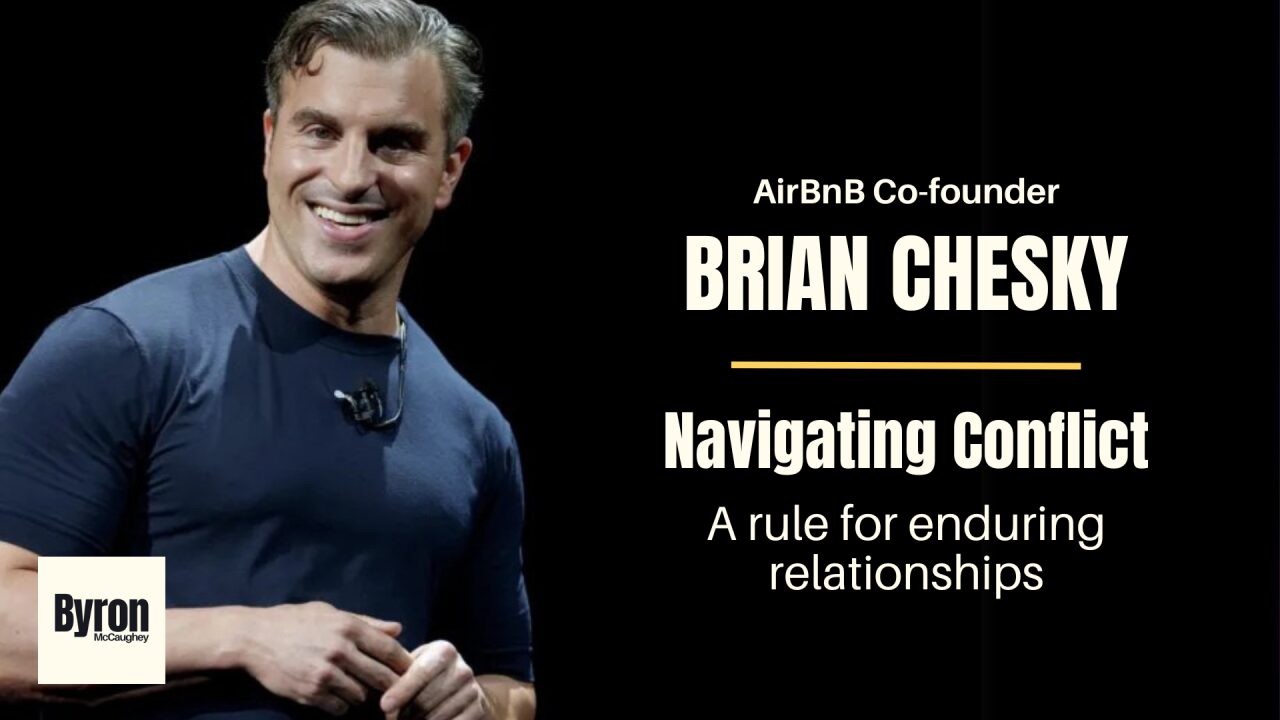
← Back to insightsBrian Chesky, Airbnb co-founder | Photo credit: Fortune
Co-founder Relationships · 2 min read
Brian Chesky: Navigating Conflict
By Byron McCaughey · 7 April 2025
"When so many co-founder stories end in conflict, what's the secret to the cohesion between you, Joe and Nate?"
That's the question Brian Chesky was asked after 18 years of building Airbnb with his two co-founders. His answer?
Winning an argument is never more important than preserving the relationship.
So how do we live by this in our own relationships?
The answer is empathy.
It’s the foundation of emotional intelligence and the bedrock of any enduring relationship - professional or personal.
It means staying flexible in the heat of disagreement, managing your own emotional reactions, and genuinely making space for the other person’s perspective.
Notice that Chesky’s rule doesn’t suggest shying away from conflict.
Quite the opposite - he speaks openly about having thousands of debates with his co-founders. For them, hard conversations are the norm - it’s how you navigate them that matters.
Here's a simple but powerful technique to try next time you find yourself in a debate: Argue Both Sides.
In my past life as an entrepreneur, when my co-founder and I had differing opinions on the way forward, we argued for both options together. No matter what side you were on, as a team, we’d passionately argue that Route A was best and then do the same for Route B.
Does this guarantee resolution? No. But it does sprinkle some empathy on the situation.
For a moment, you’re standing in the other person’s shoes. And that shift is often all it takes to create mutual respect, clarity, and a sense of shared purpose.
Because, as Chesky puts it,
“…if I win alone, I’m not going very far.”
Part of Short Tales of Psychology - a series about interesting humans and the psychological lessons we can apply to enhance our mental wellbeing and optimise performance. Subscribe here.
BM
Byron McCaughey
Psychologist for Entrepreneurs. Former VC-backed founder. Writes Short Tales of Psychology.